The Florida 25% Roof Rule: What Broward Homeowners Must Know in 2026

If a storm or leak has damaged part of your roof, one code provision decides whether you can repair it or have to replace a whole section — Florida's "25% rule." Here's exactly how it works in 2026, including the 2022 law change that lets many newer Broward roofs avoid full replacement.

Licensed Broward roofing contractor since 1999 · Plain-English guide · Updated June 2026

Licensed & InsuredFL Roofing Contractor
Since 199925+ years in Broward
4.9★ ReviewsGoogle & Facebook
Insurance ClaimsWe work with your adjuster
Free InspectionWe confirm your permit date

What the 25% rule actually says

Florida's "25% rule" lives in the Florida Building Code, Existing Building, §706.1.1. In plain terms it says this:

No more than 25% of the total roof area or roof section of an existing building may be repaired, replaced, or recovered in any 12-month period — unless the entire roofing system or roof section is brought up to the current code.

Two details trip homeowners up. First, the threshold applies to a roof section, not just the whole roof — so damage concentrated on one slope can hit 25% of that section even if it's a small share of the total roof. Second, it's measured over a rolling 12 months, not a calendar year. Several small repairs on the same roof within a year are added together, so patch jobs can quietly cross the line.

When the damaged area stays under 25%, a targeted repair is allowed and is a fraction of the cost of a full replacement. Cross 25% on an older roof, and the code can require that whole section be rebuilt to today's standards.

The 2022 change that matters most (SB 4-D)

This is the part most "25% rule" explanations still get wrong. In 2022, the Florida Legislature passed Senate Bill 4-D, effective May 26, 2022. It removed the full-replacement mandate for newer roofs.

If your roof was permitted on or after March 1, 2009 — meaning it was built, repaired, or replaced in compliance with the 2007 Florida Building Code or any later edition — then only the repaired portion has to meet current code, regardless of how much of the roof is damaged. The old 25%-triggers-full-replacement mandate does not apply to those roofs.

For roofs permitted before March 1, 2009, the original 25% threshold still applies in full: cross 25% of a section in a 12-month window, and that section must be brought up to code.

Which rule applies to your roof
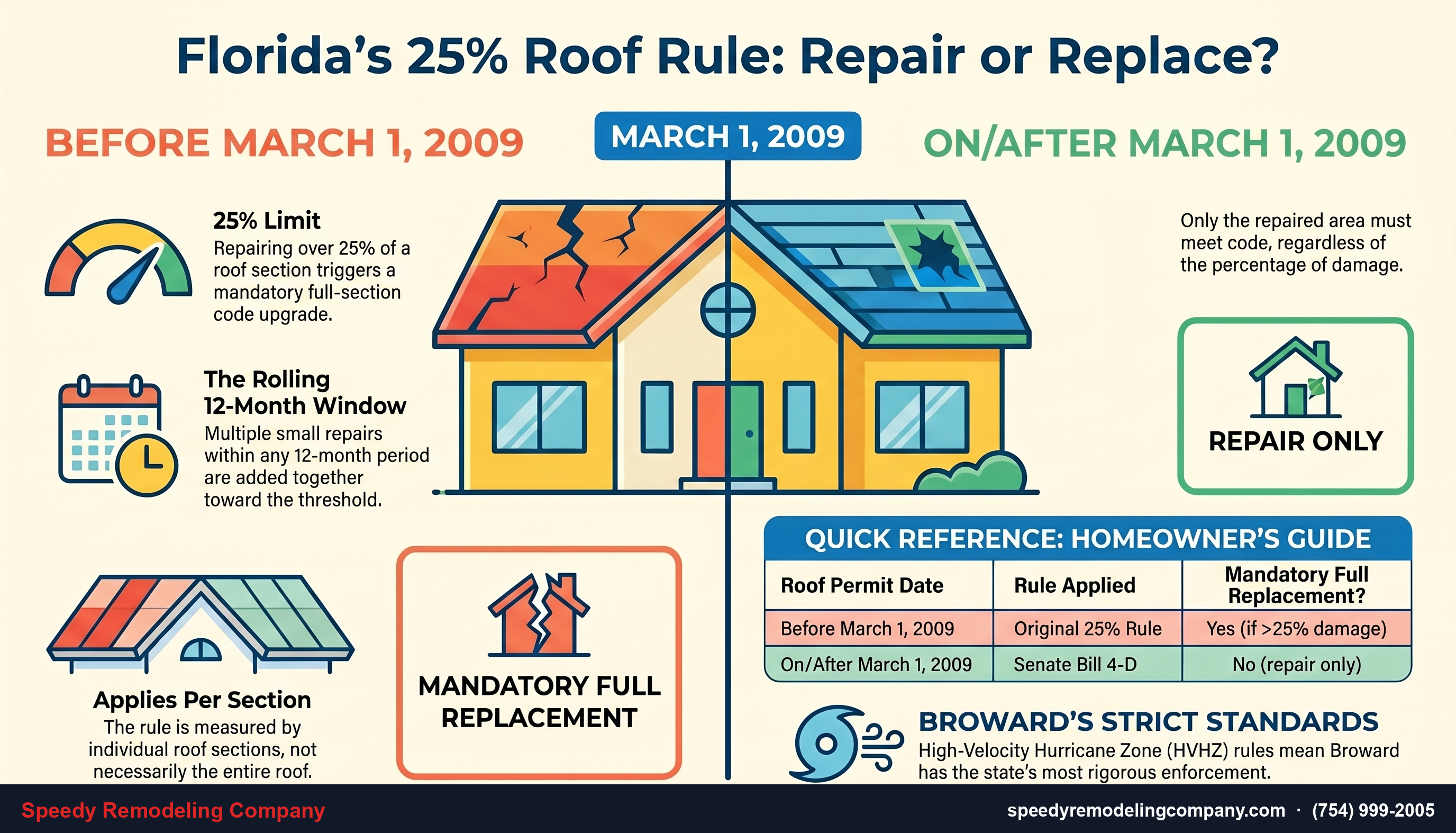
Florida's 25% roof rule explained: before vs. on/after March 1, 2009 — repair-only for newer roofs under SB 4-D, mandatory full replacement over 25% for older roofs, plus Broward's High-Velocity Hurricane Zone standards
Your roof was permitted…What the 25% rule means for you
On or after March 1, 2009 (built to the 2007 FBC or later)SB 4-D applies. Generally only the repaired area must meet current code — even if more than 25% is damaged. Full-section replacement is not automatically forced by the 25% threshold.
Before March 1, 2009The original rule applies. If more than 25% of a section is damaged or replaced within any 12-month period, that whole section must be brought up to current code.

So the single most important number for your wallet isn't the size of the leak — it's your roof's permit date. That, plus a real measurement of the damaged area, decides everything. Broward County and your city building department keep those permit records; we pull or help you locate them as part of a free inspection.

What it means for repair vs. replacement

Most leaks are still a repair

In our 25+ years across Broward, the typical leak traces to one failure point — a cracked tile, a worn pipe boot, lifted flashing in a valley. On a post-2009 roof, SB 4-D means we fix that area to code and you're done. We don't upsell a replacement the code doesn't require.

When replacement is the honest answer

On a pre-2009 roof past the 25% threshold — or any roof near the end of its life — replacement is the smarter spend, and we'll tell you in writing, with the reason. The rule exists so a "patched" roof can't keep failing; sometimes it's working in your favor.

Broward County & the High-Velocity Hurricane Zone

Broward sits in Florida's High-Velocity Hurricane Zone (HVHZ), which carries the strictest roofing standards in the state. Enforcement and interpretation of the 25% rule are handled by your local building official, and details can vary by city within Broward. Pairing the rule with HVHZ requirements and your insurer's wind-mitigation expectations is exactly where a licensed local roofer saves you money — by getting the permit, the code path, and the paperwork right the first time.

We cover your city: roof repair in Fort Lauderdale · Pembroke Pines · Hollywood · Davie · Coral Springs — and all of Broward County.
Note: This page is general information to help Broward homeowners understand how the 25% rule works in 2026 — it is not legal or code-compliance advice. Code interpretation and enforcement rest with your local building official, and specifics can vary by jurisdiction within Broward County and the HVHZ. Always confirm with your permitting authority or a licensed contractor before deciding.

Frequently asked questions — Florida's 25% roof rule

What is the Florida 25% roof rule?

It's a provision of the Florida Building Code, Existing Building, §706.1.1: no more than 25% of the total roof area or roof section may be repaired, replaced, or recovered in any 12-month period unless the entire roofing system or section is brought up to current code. If more than a quarter of a roof section is damaged within a rolling 12 months, the code can require replacing that whole section to today's standards.

Did the 25% rule change in Florida?

Yes. Senate Bill 4-D, effective May 26, 2022, removed the full-replacement mandate for roofs permitted on or after March 1, 2009 (built to the 2007 Florida Building Code or later). For those newer roofs, only the repaired portion must meet current code, regardless of how much is damaged. Roofs permitted before March 1, 2009 are still subject to the original 25% threshold.

Does the 25% rule mean I automatically need a full roof replacement?

Not necessarily. If your roof was permitted on or after March 1, 2009, SB 4-D generally means you only have to bring the repaired area up to code, even past 25% damage. If your roof predates March 1, 2009 and more than 25% of a section is damaged in 12 months, the code can require replacing that section. Confirming your permit date and measuring the damaged area settles it — that's what a free inspection does.

How is the 25% measured — per roof or per section?

It applies to a roof section as well as the total roof area, measured over any rolling 12-month period — not a calendar year. Repairs within 12 months of an earlier repair on the same roof are added together, so several small patches can cross the 25% line even if no single one does.

How do I find out when my Broward roof was permitted?

Broward County and your city's building department keep permit records. A licensed roofing contractor can pull or help you locate the permit history, which establishes whether your roof falls under the pre- or post-March-1-2009 rules. We check this as part of a free inspection so the repair-vs-replace answer is based on the code that actually applies to your home.

Is this legal advice?

No. This is general information for Broward homeowners. Code interpretation and enforcement are handled by your local building official, and specifics can vary by jurisdiction within Broward County and the HVHZ. Always confirm with your permitting authority or a licensed contractor before making a decision.

Not sure if the 25% rule means repair or replace? Find out free.

We'll inspect your roof, confirm your permit date, measure the actual damage, and give you the honest answer in writing — repair or replace, with the reason. Same-day emergency service available.

Call (754) 354-5443

Get your free estimate in 60 seconds

Chat with our AI assistant right now. Tell it what's going on with your roof and it will line up your same-day estimate on the spot. No forms, no waiting on hold.

Prefer to talk? Call (754) 354-5443 · available 24/7.

Call Now · (754) 354-5443